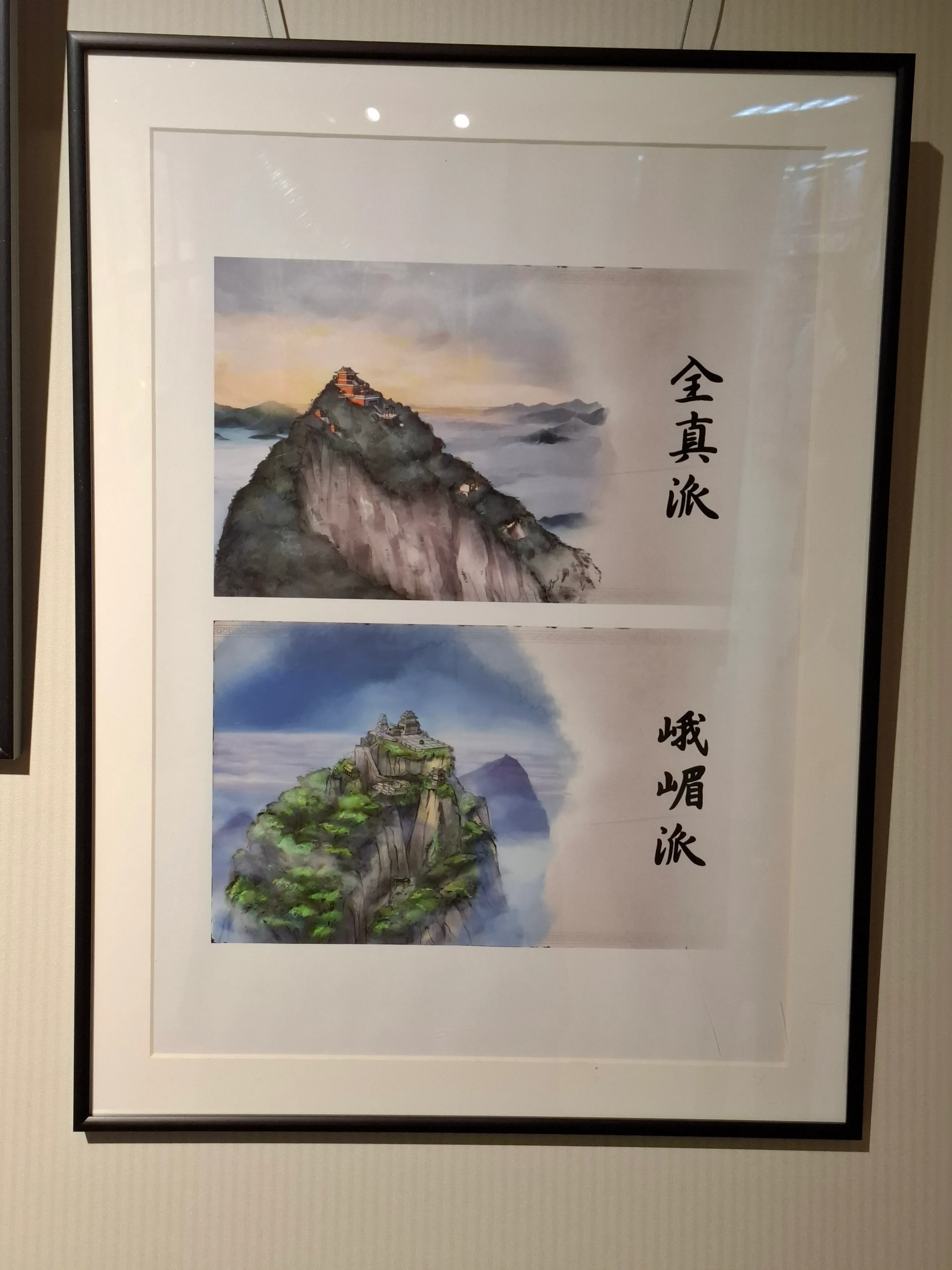
Quanzhen Sect
The orthodox school of martial arts under heaven, and one of the Six Great Sects of the Central Plains. After the Sect declined, it rose swiftly. Its followers are spread across both the Great Song and the Jin Kingdom, and it quietly surpasses Buddhism. This is partly because most of Songshan's eminent monks gave their lives in the , and partly because Quanzhen stresses the Three Teachings Unification, dissolving the rivalries between the faiths. Today Daoist temples stand everywhere in both the Great Song and the Jin Kingdom, making it the foremost sect of the Central Plains.
Strictly speaking, the Quanzhen Sect of Mount Zhongnan ought to be called the Quanzhen Longmen Sect. They draw no talismans and chant no spells; they preach true practice and true conduct, stillness of mind, and doing good for others. Sooner or later they will transcend the cycle of rebirth and ascend as immortals.
Because they blend Confucian, Daoist, and Buddhist thought, and their martial arts are easy to enter, they seem approachable beside the Sect. Relatively speaking, though, since they make no demands of natural talent, great talents rarely emerge; their followers are many, but experts are few.
Quanzhen Sword Technique
The Quanzhen Sword Technique was simplified again and again to spread the faith, then printed in great numbers and given away, billed as a Martial Arts Secret Manual that is simple to learn and good for strengthening the body.
For this, the Quanzhen Sword Technique is jokingly called the national health exercise and has become a laughingstock of the Jianghu; even the aunties on the street can twirl a clothesline pole through a move or two.
It is said that a mystery lies hidden within the Quanzhen Sword Technique: seven people working as one can lay out the Big Dipper Seven-Star Formation, and seven aunties with spatulas could beat a Wulin expert.
First Under Heaven
The founding Patriarch of Quanzhen was in his early years a scholar of the Jin Kingdom, and took top honors in both the civil and military examinations of two dynasties. Later he entered the Dao and changed his name to Wang Zhe, with the Daoist name Chongyangzi, and so is called Immortal Chongyang.
Immortal Chongyang is one of the Northern Five Patriarchs among the Five Patriarchs and Seven Immortals, a Senior among Seniors of the Wulin, a contemporary of King Yue. As the Great Song had its Alliance Leader of Letters and its Hegemon of Arms, he too was a Legend of the Wulin of the Jin Kingdom.
The Seven Immortals who sat at Immortal Chongyang's feet all became Grand Masters of their own sects. Danyangzi Ma Yu succeeded him as Sect Leader, but the Jin Dynasty's Emperor grew wary of him, ordered him sent back to his home village, and handed the affairs of Guanzhong to his Junior Brother. That Junior Brother is the man whom all the Jianghu knows, the First Under Heaven. The present Sect Leader of Quanzhen, Changchunzi Qiu Chuji.
Twenty years ago, when the Supreme Bliss Cult and the righteous factions of the Central Plains fought their great battle, Daoist Qiu was under the Jin Emperor's thumb, cultivating with his Disciples at Qixia Taixu Temple. Had the old gentleman joined the fight, the might have ended differently.
Immortal Qiu is still Sect Leader today, yet he often wanders abroad, a dragon whose head shows but whose tail never does. When he is not at Mount Zhongnan, his Disciple Daoist Yin Zhiping manages the sect's affairs in his stead.
Chongyang's Foe
Legend has it that there once was a mysterious figure in the Wulin known as Patriarch Xuanming, who styled himself as 'Chongyang's Foe.'
This Senior once preached and spread the faith in the Yinshan region, blending Daoism with the Tengri faith of the great desert, but the mood of the nation would not accept it. He turned his anger on the Quanzhen Sect, believing it blinded the people's wisdom, and went down to the Central Plains to seek out Immortal Chongyang for a martial contest and a debate on the Dao. The result was utter defeat.
To stand against Patriarch Chongyang, he went into seclusion in the Yinshan Mountains and threw himself into bitter training, working the Yin Tally to nourish his innate nature, until all six Yins were complete and his Yin Tally practice was finished, and only then did he leave seclusion.
The first thing he did upon leaving was to go up Mount Zhongnan and make trouble for Immortal Chongyang. But all had changed: during his thirty years in seclusion, his old foe had long since passed into immortality.
After a long moment of melancholy, Patriarch Xuanming laughed and laughed, and even thought of burning the Tomb of the Living Dead to force the living Immortal Chongyang to appear. The Seven Immortals came forward one after another to challenge him, and even Sect Leader Ma Danyang was no match for him.
Fortunately, had deeply inherited Immortal Chongyang's true teachings. He matched the "Six Yin Yang-Breaking Talisman" with the "Haotian Pure Yang Palm", trading eighty-one palms with Patriarch Xuanming, until the Patriarch had spent his Ultimate and, his fill of sport, left with a laugh, averting a great disaster.
The above is a serialized novel story from the Jianghu Bulletin, part truth and part invention, and only Immortal Qiu knows which is which.
Secret Manuals
- Quanzhen Sword Technique
- Carefree Wandering Leg Technique
- Dragon's Cry Skill
- Quanzhen Heavenly Escape Sword Technique
Gallery